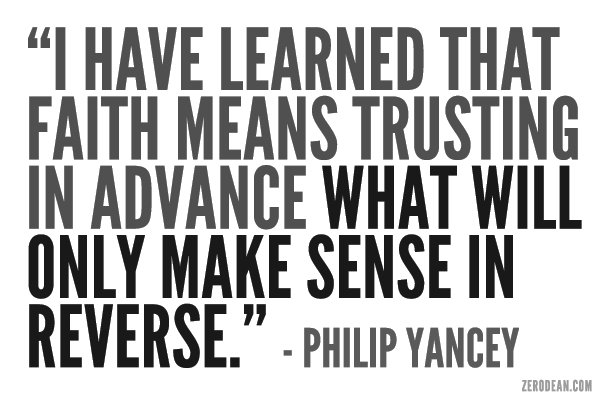
But that’s OK.

Even though multiple sclerosis is kicking her butt right now, my sister is tough. She has the will to fight through her disease and finish strong.

She was diagnosed over two years ago, but I didn’t know about her illness until recently. When she told me about it one Friday afternoon on the phone, I cried a little. I think what hurt most is that she’d been dealing with the pain and steady decline in her abilities all this time without my being available to her for support. She has a husband, as well as a strong network of friends nearby, but I was sorry that as her brother, I had not been there for her to lean on if she wanted that.

Shaky, wobbly, legs requiring a walker, and fingers that have a mind of their own are only a few of the things she’s had to endure. She had to quit work last year because she would often bump into walls, as well as forget important details after just a few minutes. Her depression deepened at this point. An occasional seizure and the inability to drive have also added to her problems.

Through this all, however, she has remained steadfast. Too many times to count, I’ve heard her say, “But that’s OK.”  Tripping over a rug and crashing to the floor — But that’s OK. I’ll make it through.  Isolation and boredom — But that’s OK. I’ve got my cat. Another medication to try, maybe one with awful side effects — But that’s OK. I’ll take it moment by moment.

faith
I remember a particular Peanuts comic strip from when I was a kid. Charlie Brown is talking with one of his friends and he remarks that he used to take life one day at a time, but now he’s down to only half a day at a time.

This reminds me of my sister. When you’ve got nothing but time, all you can focus on is the next moment or you’ll drive yourself crazy with the what ifs.

She’s been an inspiration to me in her illness. I’m dealing with my own physical problems, the outcome of which is unknown at this point. I look at her and think, If she can deal with her disease and all that comes with it, then I can handle what little I’ve got in front of me.

She’s shown me what to say to myself when I’m faced with yet another challenge. But that’s OK. Those words have power; they bring the spirits up. I can say that because I’ve used them.

An unexpected bill in the mail — But that’s OK. God will provide just like He always has. Feeling helpless when I wrap a hand around my wrist and my fingers almost touch because there’s so much less muscle there now — But that’s OK. God’s overseeing all this. He has a plan.

Neither she nor I are experiencing anything He doesn’t already know about — that’s for certain. If He believes in us enough to allow these circumstances, we can both push through. Whatever comes our way, we can both make it — But that’s OK.

Some thoughts on depression

Life really sucks sometimes; sometimes I just say to myself that this whole experiment we call life just really hasn’t worked out for me. This is a familiar theme for me; I have written about it often over the last three decades.

In fact I really feel that my whole adult life has been some kind of awful comic tragedy. Nothing that I aspired to be or do when I was growing up has happened for me. I’m sure much of this is my fault, but it’s hard for me not to feel like the deck was somehow stacked against me from the beginning.

If I could just quit it all I would. I’m not implying suicide; I could not do that. But if I could somehow just quit, walk away from it all, I believe I would do so. If I could be reassured that my family would not realize my absence, and that there would be no weird cosmic repercussions, then I would just cut my losses and go cash in my chips. I would never know the difference.

However, if I choose to look at things differently, to flip the chip over so to speak, I might have a different view. It’s true — nothing has quite worked out how I wanted it to, but does that mean that my life is as bad as I think it is? If my dreams have not been fulfilled, does that automatically mean that the end result is bad?

Many (maybe most) people would say no. I think right now I’ll have to agree with them. If I only envision one outcome, one life, as “good”, or “successful”, then I’m definitely going to be disappointed. Flexibility is crucial to enjoying life.

Even though I realize that adaptation is the key, the stubborn side of me still wants to resist. Deep down I have a sense of entitlement. I feel as though I shouldn’t have to adapt, that however I am, whatever I want, whatever I dream of being and doing, should happen just like that. The way I am is the right way and the forces of the universe should align themselves with me.

To say that this kind of thought process is crazy is really putting it mildly. I know this; I’m not trying to kid myself.

However, old habits acquired in childhood are hard indeed to break. When circumstances turn against me, quite often I just don’t feel like trying to adapt, to look on the positive side. I don’t want to change and don’t feel like I should have to — the end.

I’ve noticed something important about the way depression works in me. If I am depressed, one of two mindsets will be true. Either I will want to try to feel better, or I will wallow in self-pity and not want to change. If I feel the second way, then my belief at that time is that things outside myself should change — not me.

I believe this last sentence is a major key for helping me understand and overcome depression.

Has anyone else found this to be true in their own lives?

Sags and Bags

Looking back through old high school yearbooks is always fun for me. Taking time to sit down and revisit old memories is one of the things I like to do best. Usually it happens when I’m not expecting it. I’ll be cleaning out a closet or going through some old boxes, and all of a sudden this wonderful book of memories is in my hand.

I’ll see an old friend’s picture and I’ll think, Boy, he looks really young. Nowadays he looks old and wrinkled, telltale signs that he is losing the battle with time and aging. He’s got the same face as he had then, but it is definitely more complex now — more wrinkles, lines, and sags. Underneath is still that fresh-faced teenager, except that the passing years have added baggage to it.

It reminds me of using Photoshop to enhance a photo or drawing by adding layers to it. The original image of the person, landscape, or object is still there, only now it has been deepened with additional features.

I believe that the process and experience of writing is similar to the way a person ages.

Periodically I will take time and look through old journals of mine that I keep safely locked away in an old suitcase I bought at a yard sale. Some of the entries date back almost 30 years, but the most interesting ones I wrote in my high school and college days.

In particular, I have an old, blue, single-subject Mead notebook that we were required to journal in for my English class my senior year in high school. We would write in them, and every couple of weeks the teacher would collect them, read them, make comments, and return them to us.

The content of this particular journal is not nearly so personal as most of my other writings, due to the fact that I knew someone else would be reading it. Our teacher told us over and over to “write what is personal, but not what is private.”

Richard Nordquist does a wonderful job here of explaining the difference between public and private writing. He also tells us how keeping a journal can be therapeutic and gives us a few suggestions on how to get started. His article would have been helpful to me back in high school,  as I was often stretched in trying to find suitable topics to write about, something that was interesting to me and that I thought the teacher would find worthwhile.

Every time that I go back and read through my old Mead notebook I am amazed that some of the thoughts, feelings, and fears I had as a 17- or 18-year-old are still there, bouncing around in my brain.

I was so worried about the future back then. Many entries detailed my fear at choosing the right college for the following year, and what my life would be like one year from that day, and about girls that I liked but were too afraid to ask out. I still think in much the same way as I did then; many of the fears I have now fall along similar lines, although with more adult themes..

Even though a lot of times the subject matter I write now is very similar to what I wrote as a teenager, my emotions and my writing style are more mature, more elaborate now than when I was younger. I may write the same things I did then, but hopefully I write them better now, with more layers, more depth.

Same face, more wrinkles. Same writing style, more depth.

My years of life experience — with all its pain, sadness, happiness, and tears — makes this added dimension possible. It is something that can not be substituted with something else, nor can it ever be taken away.

  When I sat down recently to read through this treasured old notebook, I noticed a couple of very intriguing things. After a long fall and winter of lingering, grinding depression, in March of 1987 — the latter part of my senior year — I wrote down four occupations that interested me:  Air Force pilot, drummer, psychologist, and writer.

I don’t know exactly how I came up with this list, and I don’t really recall wanting to pursue any of those occupations back then (except maybe writing, but that would have been a far-fetched idea at the time).

I suppose that I did dream of these others, however, because the ink on the page still can’t lie even after all these years.

The interesting part of this story is that of the four occupations I had written down so many years prior, in the weeks leading up to this last re-reading of the journal, I had spent time thinking about three of them (the Air Force would never have let me fly with my eyesight).

It’s amazing that after all these years, and all the jobs and careers I’ve experimented with, I still return to this same core of interests.

I’ll be forever grateful to my English teacher that year, Mrs. C., for requiring us to maintain a journal. Rereading it periodically over the years since graduation has been a wonderful source of joy and inspiration.

I recently found this blog entry from Mya. It’s amazing how similar her experience is when she looks through her closet and sees clothes and accessories dating back over the years and decades. She calls it “my window to myself”. This perfectly describes how I feel about my high school journal.

The tendency to romanticize the past has always been a significant weakness of mine; it goes hand and hand with my depression. I read in my blue journal that even as an 18-year-old I was longing for a simpler time.

In my journal I recalled camping out in my backyard with my best friend when we were in fifth grade. I was nostalgic for the movies and music of that wonderful summer. Reliving those childhood days, if only in my mind, helped me deal with the stresses of facing an unknown, potentially harsh future after high school graduation.

Nowadays my writing as an adult often reflects a longing for the simpler days of high school, when my biggest concerns (as recalled almost three decades later) were homework and girls — not a mortgage, kids, health concerns, and a job that is less than glamorous.

It seems I’ve never been satisfied with my present life.

I continue striving to take joy in my life on a daily basis. Maybe I just need to listen to God a little more closely.

Church Depresses Me

DISCLAIMER/WARNING:  You have probably heard everything in this post somewhere else before, maybe several times.

Church is hard for me. Not the worship experience itself, but being around the other worshipers.

If your parents were like mine, when you were a little kid they probably made you dress up in your best clothes for church. When I was 4 or 5 I had a solid white suit that I wore with a solid white shirt, solid white tie, and solid white shoes. I don’t know why, but I loved wearing it. Too bad I kept growing.

Even though many people wear casual clothes to church these days, it seems they still try to look their best and act their best when they show up for church.

Here’s where the hard part comes in for me. It begins when I drive into the parking lot and see streams of people headed toward the door.

Wow! They look really good! Nice clothes, nice shoes, nice hair, nice makeup (on the ladies).

Then I look across the parking lot at all the cars.

Nice new SUV’s, nice clean minivans. Hey, that’s a nice BMW!

And then I look at myself.

OK, I guess I look alright on the outside. Not too bad I suppose. But look at my old Toyota. It’s got dents, a few scratches, and it could definitely use a bath.

I go inside the church to the huge auditorium. All around me are smiles and laughter as people reunite with friends after a week’s absence. Everybody looks so happy.

I don’t feel so happy myself. How am I going to make my mortgage payment next week? My wife and I had a huge fight this morning. The kids are sick. I stepped in cat puke on my way out the door. I’ve got to go back to work tomorrow for another long week. All I really want to do right now is go home and go back to bed.


Do you see the difference in the two approaches? I’m not in any way being fair to myself. I can only see the outside of the guy sitting next to me, but I know everything going wrong in my own life. I’m comparing his outer best with my inner worst. There’s no way I’m going to feel like I measure up to others taking that approach. It’s no wonder that most Sundays I feel depressed within a few minutes after getting to church.

I can’t continue these kinds of thought patterns if I hope to approach church in the right frame of mind. If I truly want to be there to worship God, then I must change the way I think.

Realistically, the way these people look may be the best they look all week. Today, they’ve got nice clothes on and are all shiny, smiley, and happy. Tomorrow morning at 9:00, they may be wearing a drab uniform or a business suit and tie they hate, have a scowl on their face and be dreading dealing with their awful boss all day.

I have no idea what is going on in the lives of all the other people seated around me at church. Logically, I know that every single person in the room has some sort of struggle that they’re dealing with. Nobody has a perfect life. The following quote is sometimes attributed to Plato, but nobody seems to know for sure who first said it:   “Be kind, for everyone you meet is fighting a hard battle.”

I applaud whoever came up with it, because it certainly makes sense. We never really know what pain somebody may be hiding just to keep up appearances on the outside. When it’s all said and done, we’ll all in the same boat.

Image

To Smile or Not to Smile

Some days life seems really good and then other days it really stinks. I can’t say certainty why I feel differently about life at different times. One interesting thing I have noticed, however, is that in the mornings when I get out of my car to walk into work, the way I feel physically will usually be mirrored by my emotional state.

For example, If I feel well-rested, without too many aches and pains in my middle-aged body, not only will I walk at a brisker pace, I’ll also feel more optimistic about the day. I may even look forward to greeting my coworkers. On the other hand, if I feel like death warmed over, I’ll  sort of stumble across the street toward the door, maybe even in a weary, zigzag manner. The thought of being cheery that early in the morning nauseates me. I just want to be left alone.

So, instead of asking myself, Which came first, the chicken or the egg?, I’m asking myself, Which comes first, physical energy (or the lack thereof) or emotions?. I believe the answer lies somewhere in between. I think one of these can both influence and reinforce the other. How then, do I break the cycle if I’m down in the dumps emotionally, AND feel exhausted and weak physically?

I have learned from various readings and seminars, that it’s possible to lift the emotions by making small physical adjustments. I know from my own personal experience that simply softening my face slightly with the smallest of smiles, causes my outlook on life to brighten immediately; everything seems better. Sitting up a tad straighter in my chair and tilting my head up slightly as if peering into the distance will also positively affect my emotions. If this seems simple, it really is. As superficial as it may appear, complex mechanisms are at work here. There is science behind this to be sure, but the processes taking place when you smile are not clearly understood yet.

In recent years several studies have been conducted that have largely come to the conclusion that your facial expressions can have a significant impact on your emotions. One study in particular that I found very interesting involved individuals whose frown muscles had been weakened or damaged by Botox; they were unable to frown. On the whole, these people reported feeling happier than individuals who had not received Botox. Interestingly, the Botox recipients also reported that they felt no more attractive than they did before Botox, thus helping eliminate the possibility of optimistic feelings based on supposed better looks. The conclusion of the study was that being unable to produce a frown kept these people in a happier mood. Other studies have made similar conclusions.

So, if you find yourself in a dreadful situation and you put on a smile to help your mood and outlook, is this a fake smile – one that denies the awfulness of the situation at hand? Or are you shrewdly altering your emotions through an intentional physical manipulation?

These questions are hotly debated for sure. In the past, I rested firmly in the camp that smiley people were simply stupid. They were ignorant of their environment and the world around them. Obviously they had not made any real attempt to look at the seriousness of life. If they could blindly smile and laugh in the face of so many critical issues and decisions to be made on a daily basis, then I wanted nothing to do with them.

Somewhere along the line, however, my opinion on the smile issue changed. Most likely it was due to numerous self-improvement teachings I encountered as I matured into adulthood. Certainly I have wavered back and forth in my beliefs over the last 20+ years, but deep down my core belief is that the world is as you make it. Smile and the world smiles with you, as the old saying goes. Two people can encounter the same negative situation with polar opposite reactions. The person who is positive and optimistic will be poised to move forward with a solution to the problem. The negative person will remain stuck, either in the present, the past, or both, asking himself, Why me?.

I can make this statement because I’ve spent a lot of time at both poles in my life, though mostly the negative pole. At this moment I’m approaching problems (challenges!) from a positive perspective, putting on a smile and looking at the world around me optimistically. Not long ago, however, I sat daily on my stump of criticism, cursing the “beautiful” people who seemingly had more stuff than I did.

I’m sure I’m not done being negative; the depression I battle often knocks me off the tightrope on which I try to balance my emotions. The only thing I can really do is to keep working on myself on a daily basis. That’s all any of us can do.

The Lazy River

Below is a piece I wrote a few months back, when I was in a much different place spiritually and emotionally.  I’m posting it here now because when I recently went back and reread it, I was stunned by the raw emotion within it.  I have edited it only slightly for content, so please forgive the grammar.  I have written a response to this piece, which follows this post.


I want to believe and trust in you Lord.  I want so badly for this to be the norm to be who I am just like it was years and years ago – back when it was easy to trust you and I didn’t question everything.  I just took your word as it came, realized and accepted that the promises were for me and carried on with life, trusting you for things. Oh, it wasn’t always that easy and simple – by no means was it that way.  But at several points in my life it WAS that way, I did trust you and feel one with you, believing that you had my best interests at heart, believing that you loved me and cared for me.  I guess deep down I still believe those things – that you want only the best for me.  However, it’s so easy now to doubt all that.  I’ve been through so many trials, so much heartache, so much pain and numbing depression for so long that I can’t help but doubt, can’t help but wonder what the reason is for all this.  I wonder what purpose you could possibly have in mind for all this.  I wonder why you don’t make it all go away.  I believe that you have the power to make it disappear once and for all.  You have the power to enable me to enjoy life, to begin each day knowing that there’s a reason, a purpose that I got out of bed, that it’s not just another random day in my boring, monotonous life.  I believe that you can do all this, so why don’t you?  Why don’t you allow me some happiness like I used to have in my life?  Why did I have to peak at 13, 14, 15?  I’m now 42 – that’s a long time to struggle and be unhappy.  Yes, I’ve had a few good times, but they have been few and far between.  And lately they’ve been very few with a lot of in between.  I remember Daddy sitting on the carport almost every night after work, after a swig or two of whiskey.  He’d drink coffee and smoke, just staring off into the distance toward the end of the lot.  What was he thinking about all these years, when he was 50 or 60 years old? – after I’d already come onto the scene.  Was he pondering his failures in life?  Was he wishing that he’d never contracted TB and had to leave the city, bitter that he was living out his life in a podunk little town?  Probably he thought about all these things and many more which I’ll never know about, never coming close to thinking about.  What deep, dark secrets had he packed away in his head?  The bigger question is this: will I be doing this same thing for the rest of my life?  Will I sit and stare and ponder and regret and wish and hope – not dreaming, because those days are long past.  It is too late for dreams now.  They are things for youth, those who have energy and zest for life, those who have not been weighed down by heartache and pain and disappointment and depression for decades.  For years now I have sat outside, mostly in the evenings, pondering, regretting, mournful about the past, bitter about the future, feeling stuck in a drab, joyless existence for the rest of my days – feeling powerless to change anything in my life, resigned to accept what I’ve got and drift along with the current through the rest of the lazy river of life, until I reach the end and have to turn in my innertube.  It’s not been a fun ride.  I thought these things (life) were supposed to be pleasant, relaxing, enjoyable.  I look around and see others taking pleasure in their ride.  They’re laughing with family and friends, enjoying a cool drink along the way, kicked back on their innertube, sunglasses and sunscreen on to protect them from too much of a good thing.  Then I look at myself — I have none of those things.  Yes I have a family to enjoy (which I do), but no cool drink, no sunglasses, no sunscreen.  I’m squinting from the glare all the way around the path.  And I’m not even on the innertube, just holding on with one arm while in the water, shoulders getting more and more sunburned.  Yes, there are others I notice who don’t even have an innertube.  They’re dog paddling, trying to stay afloat and conserve their energy at the same time, hoping not to get a cramp before they reach the end.  Looking at their plight does, in a way, make me thankful for my innertube to hang on to, thankful for my family to talk to.  But, it also causes me to question the ride, the whole experience.  Why do these people have so little, when others have so much?  Why is that elderly man so miserable on his journey, fighting to keep his head above water with nothing to grasp on to, when just a few feet away a 20-something sips his lemonade, holds hands with his young wife, and playfully dangles his feet in the same water which threatens to overtake the old man?  Why was he not given an innertube as well?  It doesn’t seem fair.  Oh, I know – nobody ever said life was fair.  But what about the fact that none of us even asked to get on this ride?  We didn’t sign up for it, not me, not the old man, not the 20-something.  We all just somehow found ourselves here, only in vastly different circumstances.  We didn’t ask to get on the ride, and we can’t get off the ride (oh, there’s a way, but it’s not desirable).  The old guy can question aloud why he didn’t get an innertube, but nobody has acknowledged him yet, much less given him any relief.  I’d like to have some sunglasses, even a cheap dollar store pair, but so far nothing.  I squint while another smiles with ease.